
5 Signs of Gum Disease Most People Ignore (Until It's Too Late)

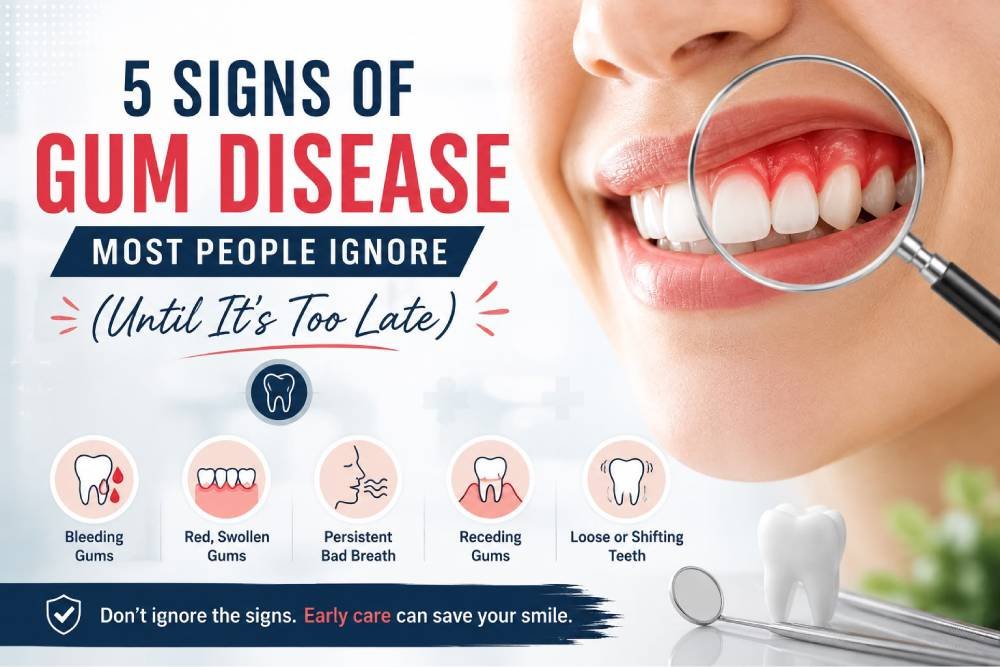
Most people obsess over their teeth — whiteness, straightness, that one chipped edge — but gums only get attention when something's clearly wrong.
That's the problem. Gum disease doesn't announce itself. It shows up in small, easy-to-dismiss ways first, and by the time it's impossible to ignore, it's often past the stage where it's easy to fix.
Here are five gum disease symptoms people brush off constantly, and what your gums are actually trying to tell you.
1. Bleeding Gums While Brushing
A little pink in the sink while brushing gets blamed on the toothbrush almost every time. "I must've pressed too hard."
Here's the truth: bleeding gums are not normal. It's one of the clearest early signs of gingivitis, the mildest and most reversible stage of gum disease. That bleeding is inflammation — your gums reacting to plaque and bacteria along the gumline.
2. Bad Breath That Nothing Seems to Fix
If your breath doesn't stay fresh no matter what you try — mouthwash, gum, brushing twice a day — it might not be a hygiene habit issue at all. Persistent bad breath, or halitosis, is one of the most searched gum disease symptoms online, and for good reason: it's often caused by bacteria trapped below the gumline, quietly breaking down tissue and releasing odor as a byproduct.
Mints mask it for twenty minutes. They don't touch what's actually causing it.
3. Gums That Look Red, Puffy, or Swollen
Healthy gums are firm and pale pink. If yours look red, shiny, or slightly swollen — especially where the gum meets the tooth — that's active inflammation. It's one of the most visible signs of gum disease, and also one of the easiest to catch early, simply because you can see it, if you bother to look.
4. Teeth That Suddenly Look "Longer"
This one creeps up slowly. One day your teeth look a little longer than you remember, or a small gap forms near the base of a tooth.
That's gum recession — gum tissue pulling back and exposing more of the tooth underneath. Unlike bleeding or swelling, receding gums don't bounce back easily once they've pulled away.
5. A Loose or Shifting Tooth
This is the final warning, and it's the one that should never be brushed off.
If a tooth feels like it's moving, even slightly, or shifts when you bite down, it usually means the bone and tissue supporting that tooth have already weakened. At this stage, gum disease has progressed from gingivitis to periodontitis, and home care alone typically isn't enough to reverse it.
Why This Matters
Gum disease is caused mainly by plaque — a sticky film of bacteria that builds along the gumline daily and hardens into tartar if ignored. Smoking, hormonal changes, certain medications, diabetes, and genetics can all make it worse.
The good news: gingivitis is reversible. It's periodontitis, the advanced bone-loss stage, that becomes permanent. A few starting points if any of these signs sounded familiar:
- Brush at an angle toward the gumline, not just across the tooth surface
- Floss daily — most plaque hides exactly where brushing misses
- Use an antibacterial mouthwash, not just a breath-freshening one
- Get a professional cleaning to remove tartar you can't reach at home
- If you smoke, know it's one of the biggest accelerants of gum disease
Don't Wait for the Final Sign
A loose tooth is the last warning your gums give you, not the first. The four signs before it — bleeding, bad breath, swelling, recession — are your actual window to act while gum disease is still reversible.
If even one of these sounded a little too familiar, don't just close this tab and move on. Reach out to us at Forever Smiles — covering exactly what causes gum disease and how to reverse it at an early stage.